The difference between a good gratin and a great one comes down to one decision most people get wrong: they slice the potatoes and walk away. What’s actually happening in a properly executed dish is a controlled starch release — the potato’s own starch thickens the cream from the inside while the slices soften evenly, and the cheese emulsifies rather than splitting into oil and rubber. Cheesy au gratin potato recipes everyone is obsessed with all rely on the same discipline: the right potato, thin uniform slices, dairy that won’t break under heat, and a low, patient oven. Get those four right and you get a cross-section that holds its layers, a sauce that clings, and a top that browns without the interior turning to glue.
Prep time: 20 minutes | Cook time: 75 minutes | Total time: 95 minutes | Servings: 6
Table of Contents
What Makes This Recipe Work
- Starchy potatoes do the thickening themselves. The science here is simple: high-starch varieties leach amylose into the cream as they cook, giving you a naturally bound sauce without a roux. This is why you never rinse the sliced potatoes — that rinse washes away the exact starch you need.
- The slices are uniform and thin. This is intentional. At 3 mm, every layer cooks at the same rate and fuses into a coherent stack. Uneven slices mean some layers are raw while others turn to mush — the single most common gratin failure.
- The dairy is warmed before it hits the oven. Most recipes skip this and pour cold cream over cold potatoes, which extends bake time by 20 minutes and invites the sauce to break. Warm cream starts thickening immediately.
- Cheese is layered, not just piled on top. A modest amount worked between the layers builds savoriness throughout, while the reserved portion on top delivers the browned crust. Loading it all on top gives you a greasy cap over bland potatoes.
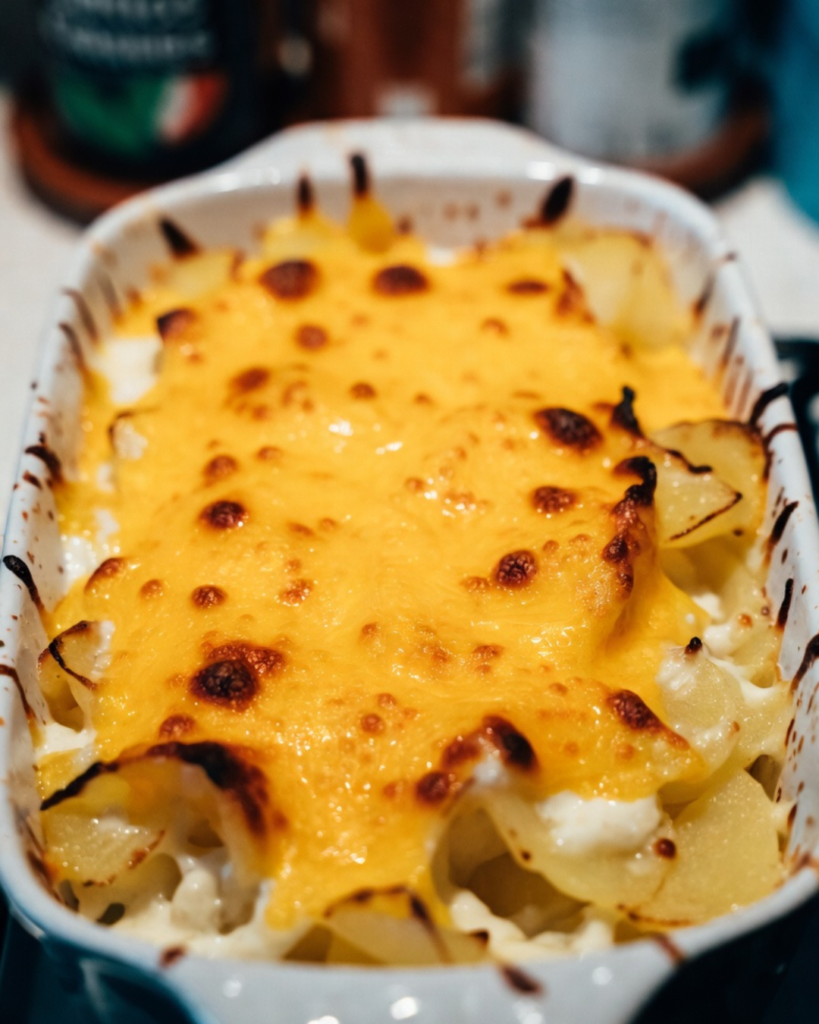
Ingredients — What to Buy and Why It Matters
For the potatoes and sauce:
- 1.1 kg (about 2.5 lb) Yukon Gold potatoes — the critical choice here. Yukon Golds sit in the medium-to-high starch range with enough waxiness to hold their shape, so you get bound sauce and intact layers. Russets go too soft and grainy; pure waxy potatoes like red bliss won’t thicken the cream at all.
- 480 ml (2 cups) heavy cream, 36% fat minimum — do not substitute milk or half-and-half. Below roughly 30% butterfat, the sauce has too much water and will curdle against the salt and cheese. The fat is what carries the emulsion.
- 3 garlic cloves, smashed — infused into the cream, not scattered raw.
- 2 sprigs fresh thyme
- 1/2 tsp freshly grated nutmeg — small amount, non-negotiable. Nutmeg is the classic foil to heavy dairy and cuts the richness perceptibly.
- 1 tsp kosher salt, plus more for layering
- Freshly cracked black pepper
For the cheese:
- 200 g (about 2 cups) Gruyère, grated from a block — the correct cheese for gratin. Gruyère melts smoothly, browns beautifully, and brings a nutty depth that mild cheeses can’t. Grate it yourself; pre-shredded cheese is coated in cellulose and starch that won’t dissolve and leaves the sauce gritty.
- 50 g (about 1/2 cup) Parmigiano-Reggiano, finely grated — for the top, where its low moisture and high salt drive browning.
- Substitutions, honestly: sharp white cheddar can replace up to half the Gruyère for a more familiar, tangier profile, but cheddar breaks more easily under heat — keep the oven low if you use it. Comté is a direct, excellent swap for Gruyère. Avoid mozzarella; it’s too wet and turns the dish stringy rather than creamy.
- 15 g (1 tbsp) butter, for the dish
Step-by-Step Instructions
- Heat the oven to 160°C (325°F). Low and slow is deliberate. A hot oven browns the top before the interior cooks and encourages the cream to break. Butter a baking dish roughly 23 x 33 cm.
- Infuse the cream. Combine cream, smashed garlic, thyme, nutmeg, salt, and pepper in a saucepan. Bring to a bare simmer over medium-low, then cut the heat and let it steep 10 minutes. What’s actually happening is a gentle extraction — the aromatics release into the fat, seasoning the entire dish from within. Fish out the garlic and thyme stems.
- Slice the potatoes to 3 mm. Use a mandoline for uniformity — this is where a knife almost always fails. Do not rinse the slices. The surface starch is your thickener. Work just before assembly so they don’t oxidize.
- Build the first layers. Shingle a third of the potatoes across the dish, overlapping like roof tiles. Season lightly with salt and pepper, then scatter a portion of Gruyère. Repeat for a second layer.
- Add the final potato layer and the warm cream. Lay the last third of the potatoes, then pour the warm infused cream evenly over the top. Press down gently with a spatula until the liquid rises to just below the surface. The critical step here is contact — every slice needs to be in the cream to cook evenly.
- Top and cover. Scatter the remaining Gruyère and all the Parmigiano across the surface. Cover the dish loosely with foil, tented so it doesn’t touch the cheese.
- Bake covered for 45 minutes. The potatoes steam and soften in the cream during this phase. Test with a paring knife — it should meet mild resistance, not crunch.
- Uncover and bake 25–30 minutes more. This is where the top browns and the sauce reduces to a clinging consistency. Pull it when the surface is deep golden and the edges bubble slowly.
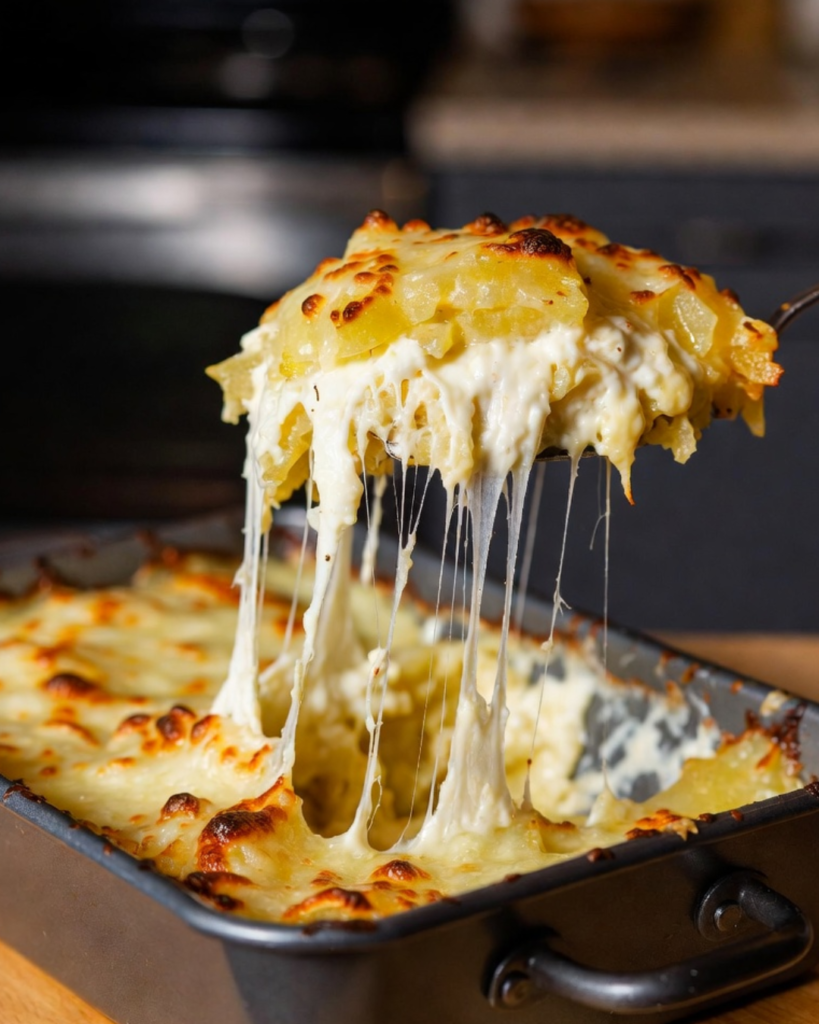
- Rest 15 minutes before serving. This is non-negotiable. Straight from the oven the sauce is loose and the layers slide; 15 minutes lets the starch set so you can cut clean squares that hold their shape.
Technique Notes for Better Results
- Where most home cooks go wrong: rinsing the potatoes after slicing. It feels tidy and it destroys the dish. The starch clinging to each slice is your entire thickening system — wash it off and you get watery cream pooling under raw-tasting potatoes.
- The professional approach is to warm the cream first. Cold dairy poured over cold potatoes into a cool oven is a recipe for a broken sauce and a 20-minute-longer bake. Warm cream is already halfway to set.
- Use a mandoline, and mean it. Hand-slicing produces variance you can’t see until it bakes unevenly. Uniform thickness is the difference between coherent layers and a mix of raw and disintegrated.
- Keep the oven at 160°C. The temptation to speed things up at 200°C is exactly how the top scorches over an undercooked middle and the cream splits. Patience is the technique.
- Season every layer, not just the cream. Potatoes are bland and absorb enormous amounts of salt. A pinch between layers seasons from within; relying on the cream alone leaves the interior flat.
- The precision tip: let it rest, then run a torch or broiler over the top for 60 seconds if you want a deeper crust without overbaking the interior. It re-crisps the surface after the rest without pushing more heat into the potatoes.
Plating and Serving
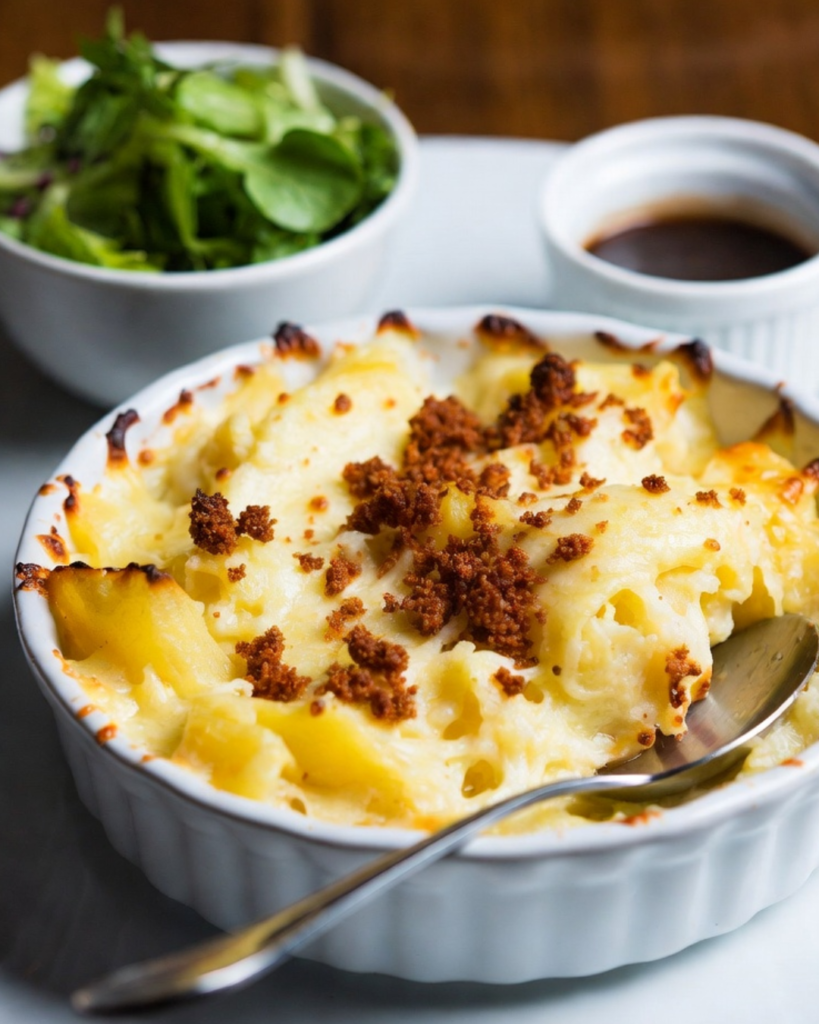
- A sharp green salad with vinaigrette — acid and bitterness against all that rich dairy. This contrast isn’t optional; it resets the palate between bites.
- Roast beef, pork tenderloin, or a simple roast chicken — gratin is a supporting player, and lean roasted meat is its natural partner.
- Blanched or roasted green beans — a crisp, green counterpoint to the soft, creamy potatoes.
- Presentation: cut clean squares with a sharp knife, lift with an offset spatula so the layers stay stacked, and set each portion so the cross-section faces the diner. Those visible layers are the whole appeal. Finish with a few thyme leaves and a crack of pepper.
- Beverage pairings: an unoaked Chardonnay or a dry Riesling — acidity that cuts the fat. For red, a light Pinot Noir won’t fight the dish. Non-alcoholic: sparkling water with lemon for the same acid function.
Nutritional Profile
Per serving, this lands around 420–480 calories, with roughly 14 g protein, 30 g fat, and 32 g carbohydrate. Potatoes are a strong source of potassium — more per serving than a banana — along with vitamin C and resistant starch that supports gut health, particularly after the dish cools. Gruyère contributes calcium and complete protein, and being an aged cheese, it’s low in lactose. The richness is real, but so is the nutrient density beneath it.
Modifications, with honest trade-offs:
- Lighter version: replace one cup of cream with whole milk plus 1 tsp cornstarch to compensate for the lost thickening. The sauce will be thinner and less luxurious — the starch mimics viscosity but not the mouthfeel of fat.
- Gluten-free: this dish is naturally gluten-free as written, since the potato starch does the thickening no flour required. Verify only that your cheese carries no added starch.
- Lower fat, higher protein: substitute part of the cream with evaporated milk. It resists curdling better than fresh milk and adds protein, but brings a faintly cooked, caramelized note some find off.
- Dairy-free: full-fat coconut cream and a plant-based Gruyère-style cheese can approximate the texture, but expect a distinct coconut background note and weaker browning.
Common Questions, Answered Directly
Why is my gratin watery? Two usual causes: waxy potatoes that didn’t release enough starch, or the slices were rinsed. Use Yukon Golds, never rinse, and let the dish rest 15 minutes so the sauce sets.
Why did my sauce curdle? Oven too hot, or dairy too lean. Keep it at 160°C and use cream with at least 36% fat. High heat and low fat are what break the emulsion.
Can I make this ahead? Yes, better than most baked dishes. Assemble fully, refrigerate up to 24 hours unbaked, and add 10 minutes to the covered bake from cold. Or bake fully, refrigerate, and reheat covered at 150°C until hot through.
Do I have to peel the potatoes? No. Scrubbed Yukon Gold skins add texture and hold the layers together. For a refined, silky presentation, peel them; for rustic character, leave them on.
Can I freeze it? Poorly. Cream-based sauces separate on thaw and the potato texture turns grainy. This is a dish to make fresh or hold refrigerated for a few days, not freeze.
Slice thin and even, never rinse away the starch, and give it a full 15 minutes to rest before you cut. Do those three things and the layers will hold, the sauce will cling, and you’ll understand exactly why this dish earns its reputation.
About The Author